Perspectives

The payment industry in Canada


Authors

 

Image
Stephen Yun headshot

Stephen Yun 

Senior Research Analyst

Stephen Yun is a Senior Research Analyst at Payments Canada, whose areas of focus include the Consumer Payment Methods and Trends and Payment Behaviour Tracking studies, and leveraging research insights to create a consumer/business payment narrative and drive business action for his business partners.

 

Image
Headshot Gillian Monkton

Gillian Monckton 

Senior Policy Analyst

Gillian Monckton is a Senior Policy Analyst at Payments Canada on the Policy and Government Relations team, leading policy files related to membership expansion, Lynx and the Real-Time Rail, in addition to supporting Payments Canada’s Government Relations function.



Image
Peter Brown's headshot

Peter Brown 

Senior Policy Analyst

Peter Brown is a Senior Policy Analyst at Payments Canada, joining the Policy and Government Relations team early in 2025. He is leading policy files related to the Automated Clearing Settlement System (ACSS) and observing the Prominent Payment System (PPS) designation.


This article was originally published in the October 2025 volume of the Journal of Payments Strategy & Systems (JPSS), a publication that focuses on emerging issues, trends and developments in payments. Payments Canada was requested to contribute this Canadian perspective to JPSS’s series of country-specific reports, which offer regional insights on payment strategy and systems.


Introduction

The Canadian economy relies on the safe, efficient and cost-effective movement of funds between consumers, businesses and finan­cial institutions. Payments Canada owns and operates Canada's critical national clearing and settlement systems, which include the technology infrastructure, by-laws, rules and standards that facilitate this movement of funds in a safe, efficient and sound manner. Its systems clear and settle hundreds of billions of dollars every day between member finan­cial institutions to ensure that the Canadian economy continues to function and thrive.

The Canadian economy is one of the most secure and robust in the world; consumers and businesses have a variety of safe payment options available to them via financial institu­tions and payment service providers (PSPs). However, the financial landscape in Canada is evolving with the emergence of new players and payment solutions.

Payments Canada's systems are under­going various modernisation efforts in order to reflect this evolution. Canada is pursuing adaptive changes to ensure consumers and businesses have access to secure, modern payment options that support the country's global competitiveness.

Research shows that Canadian consumers and businesses are generally well served within the financial system. This paper pro­vides an overview of the Canadian payment ecosystem, focusing on Payments Canada's role, key initiatives being undertaken and consumer payment trends. The paper will also discuss future trends and considerations in payments, and how these developments will support inclusion and participation in the Canadian economy.

The Canadian payment ecosystem: The role of Payments Canada

As a public purpose, non-profit organisation, Payments Canada plays a critical role in facili­tating modernisation in the Canadian payment ecosystem. Created under the Canadian Payments Act (CP Act) 1980, Payments Canada owns and operates the critical payment infrastructure that supports the financial and economic well-being of all Canadians.

Unlike some international counterparts, Payments Canada operates independently from Canada's central bank, the Bank of Canada, and is legislatively mandated to:

  • Establish and operate national systems for the clearing and settlement of payments and other arrangements for the making or exchange of payments.
  • Facilitate the interaction of its clearing and settlement systems and related arrange­ments with other systems involved in the exchange, clearing or settlement of pay­ments.
  • Facilitate the development of new payment methods and technologies.

Payments Canada is driven by a public purpose mandate to ensure the efficiency, safety and soundness of its payment systems and take into account the interests of users. The fol­lowing section describes this framework for membership and system participation.

Membership and system participation

The CP Act defines the types of entities that are eligible to become members of Payments Canada and participate in Payments Canada's systems. Membership is mandatory for certain entities, including the Bank of Canada and all chartered banks operating in Canada.1 Additionally, securities dealers, trust and loan companies, credit union centrals, life insurance companies, federations of caisses populaires and other deposit-taking institutions are eli­gible to apply to become members.

Historically, membership consisted predominantly of traditional financial institu­tions, such as banks and federally regulated credit unions. Following amendments to the CP Act in 2001, membership eligibility was expanded to life insurance companies, securi­ties dealers and money market mutual funds.

In addition to benefiting from member services, including payment guides, resources and research, members of Payments Canada are eligible to apply to participate on Payments Canada's systems. These systems are used by our members to support the flow of pay­ments that keeps Canada's economy moving.

Payments Canada owns and operates three payment systems:

Lynx is an electronic wire system that facili­tates the irrevocable transfer of payments in Canadian dollars between participating financial institutions.2 In addition to pro­viding a means for settling obligations between participants, Lynx also supports the implementation of the Bank of Canada's monetary policy by managing the amount of liquidity in the financial system.

The ACSS primarily clears and settles retail payments representing most of the day-to­day commerce in Canada, including cheques, pre-authorised debits, direct deposits, bill payments and automated banking machine (ABM) transactions. Payments Canada is currently working with the Bank of Canada, the Department of Finance, members and stakeholders to modernise the ACSS.

Given the critical role these systems play in the Canadian economy, both systems are overseen by the Bank of Canada.3 Under the Payment Clearing and Settlement Act (PCSA) 1996, the Bank of Canada is respon­sible for designating and overseeing financial market infrastructures, and ensuring these systems are adequately controlling systemic and/ or payment risk. Lynx is designated as systemically important, while the ACSS is designated as a prominent payment system (PPS).4 When the RTR is operational, it will also fall under the oversight of the Bank of Canada as a PPS.

Payments Canada is responsible for ensuring that its systems adhere to the risk ­management standards developed by the Bank of Canada. These standards fully incor­porate the Principles of Financial Market Infrastructures in order to ensure the mitiga­tion of systemic or payment system risk.

Share icon

Canadian payment ecosystem initiatives

The payment ecosystem in Canada is in the midst of transformational change. New market entrants, evolving legislation, payment modernisation initiatives and the emergence of new technologies and services are changing the landscape of payments in Canada. Enabling positive change and pro­moting greater competition in the payment ecosystem is a strong priority for Payments Canada. The key pillars of payment mod­ernisation in Canada are described below. 

Regulation of payment service providers under the Retail Payment Activities Act 

The Bank of Canada has introduced a new retail payment supervisory regime for PSPs that perform retail payment activities.5 This includes providers that maintain accounts or hold funds for end users (ie digital wallets), initiate electronic funds transfers (EFTs) at the request of an end user, or provide clearing and settlement services. PSPs will be required to register with the Bank of Canada and subject to certain requirements aimed at safeguarding end-user funds, mitigating operational risks and building confidence in the Canadian retail payment sector. 

Expansion of eligibility to become a member of Payments Canada

Amendments to the CP Act will expand membership eligibility to include PSPs captured under the Retail Payment Activities Act 2021, provincial credit unions that are a member of a credit union central, and clearing houses of clearing and settlement systems designated under the PCSA.6 This is the result of years of advocacy for expanded access to Payments Canada's systems, both for new and smaller players. Expanded member­ship and eligibility to participate on Payments Canada's systems provide an opportunity to foster greater competition and promote inno­vation in the Canadian payment ecosystem.

Launch of a real-time payment system

Payments Canada is currently building Canada's first real-time payment system: the Real-Time Rail (RTR). Real-time payments will transform Canada's economy, giving businesses and consumers more transparency and access to their payments 24/7/365. The RTR will facilitate this transformation while ensuring transactions are safe, secure and irrevocable. Further, the RTR is being built to enable fair, open and risk-based access to new and smaller participants, including PSPs. In addition, reflecting lessons learned from the launch of real-time payment systems in other jurisdictions, the RTR will be one of the first real-time payment systems to include centralised fraud services on day one. 

Modernising the batch system

Since its launch, continuous upgrades and enhancements have ensured the ACSS operates with optimal efficiency, safety and functionality. Payments Canada continues to work with the industry to accommodate change and evolution in retail payments. This includes enhancements to the way pay­ments are processed in the ACSS to ensure the future state of retail batch payments meets the Bank of Canada's PPS standards and the changing needs of Canadians.7

Development of the consumer-driven banking framework

The government of Canada is developing and implementing a consumer-driven banking framework that will enable con­sumers and small businesses in Canada to transfer their financial data securely through an application programming interface. This will allow consumers to use secure data­driven financial services that can improve their financial outcomes. Currently, the scope of consumer-driven banking is limited to include read-only access (data activities), but consideration may be given in the future to expand the framework to include write access functions (account activities). The government of Canada released guidance on open banking, along with accompa­nying regulations, set to come into effect in autumn 2025, with delivery of a fully opera­tional framework by early 2026.8

Alignment with international message standards 

The Society for Worldwide Interbank Financial Telecommunication (Swift), the global cooperative that operates the Swift network, utilises standardised codes and unique identifiers to enable financial institutions to send and receive payment instructions in a common language. Swift is decommissioning its existing standard in favour of ISO 20022, with universal adop­tion expected by November 2025. The ISO 20022 standard will ensure richer data ele­ments and structured message components to promote greater harmonisation, accuracy, fraud prevention, efficiency and payment processing. This is particularly important for smaller financial institutions or new entrants in the system, given the potential benefits and cost savings associated with adopting this international standard.9 Payments Canada's high-value payment system, Lynx, and the future RTR are ISO 20022-com­patible systems. By adopting ISO 20022, users of Canada's payment infrastructure will benefit from enhanced payment infor­mation, global interoperability to facilitate cross-border payments and efficiency in payment processing.

Payment trends in Canada

Payment activity and trends are influenced by a variety of macroeconomic factors, including inflation, interest rates and broader market uncertainty. In 2023, the Canadian economy approached pre-pandemic levels of growth, and as a result, the total payment market in Canada experienced modest growth in both volume and value. A total of 21.7 billion transactions, valued at CAN$11.9 trillion, were conducted in 2023, an increase of 6 per cent and 1 per cent from 2022, respectively.10

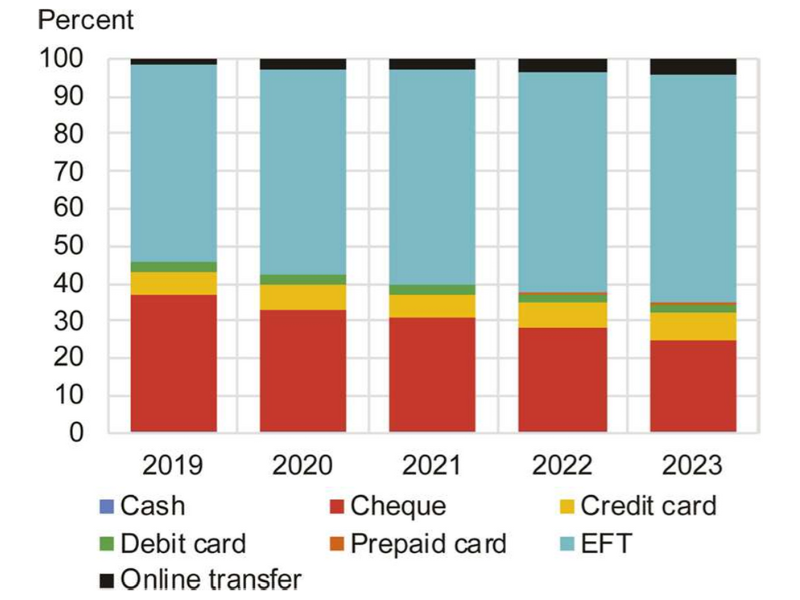
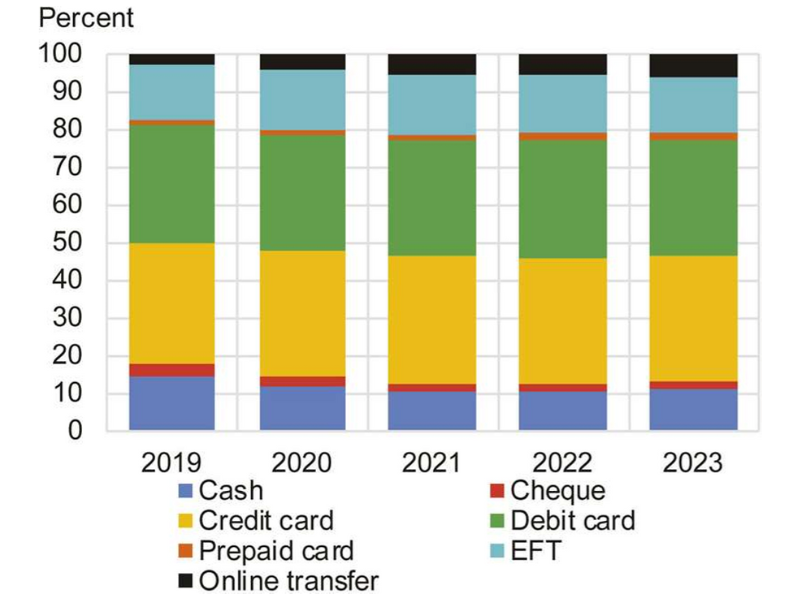
When making a purchase, Canadian con­sumers and businesses can choose to use cash, cheques, debit cards, credit cards or electronic payment services. Survey data from the Bank of Canada show broad consumer acceptance of different payment methods at the point of sale, as well as a shift towards cards and other electronic payment methods.11 Likewise, the vast majority of merchants accept multiple payment types, including well-established methods, such as cash and payment cards, in addition to other methods, such as Interac e-Transfer. Consumer behaviour trends show a continued reliance on paper items, alongside an increase in card payments (see tables one and two). Canadian consumers are increas­ingly supportive of digital payment offerings, but are increasingly aware of the risk of fraud, emphasising the importance of cyber security measures in payments. 

Paper

Cash and cheques 

Although the use of cash has fallen in recent decades, cash transactions (by volume) have stabilised in the last few years, and many Canadians returned to using cash for low ­value transactions following the COVID-19 pandemic. Cash transaction volume continued to build on its gains made in 2022, increasing by 15 per cent in 2023, ranking fourth overall as measured by payment volume.12

Table one: Canadian payment trends, by payment type, value (Canadian dollars, millions) 2019-2023

Year

Cash

Cheque

Credit card

Debit card

Prepaid card

Electronic funds transfer

Online transfer

2019

65,159

3,586,221

595,114

259,255

19,337

5,178,683

178,225

2020

51,347

3,056,371

574,310

251,731

17,884

5,147,089

249,123

2021

58,415

3,281,753

678,462

272,819

19,670

6,225,588

324,790

2022

60,122

3,212,624

799,976

295,013

21,776

6,931,749

387,255

2023

62,590

2,864,460

847,387

302,224

24,040

7,247,042

464,053

Table two: Canadian payment trends, by payment type, volume (millions) 2019-2023

Year

Cash

Cheque

Credit card

Debit card

Prepaid card

Electronic funds transfer

Online transfer

2019

2,957

584

6,552

6,256

326

2,947

541

2020

2,247

432

6,223

5,699

303

2,908

801

2021

2,038

404

6,469

5,964

313

3,081

1,007

2022

2,077

405

6,794

6,315

331

3,101

1,118

2023

2,380

379

7,150

6,634

349

3,179

1,278

Source: Payments Canada (2024) 'Canadian Payment Methods and Trends Report'


Over half of Canadians (55 per cent) have no desire to go completely cashless.13 Cash is considered a fast and reliable payment option, attributed to its wide acceptance and its immunity to technological issues and depreciation. In 2023, over half of all Canadian businesses accepted cash as a payment option, but sentiment shows a shift toward the acceptance of digital and elec­tronic alternatives. 

The use of another paper payment item, cheques, is steadily declining as electronic alternatives gain popularity, but Canadians still use over 350 million cheques each year. Similar trends have been noted interna­tionally, with some jurisdictions opting to phase out the use of cheques as part of their payment system modernisation efforts. 

Certain groups of consumers and businesses continue to rely on cheques, and the govern­ment has policies aimed at supporting groups who use these payment methods (i.e., the ability to cash a government cheque at any financial institution).14 Cheques also remain the most widely accepted payment method, with more than two-thirds (70 per cent) of Canadian businesses accepting cheques in 2023. Canada's ACSS is one of the most efficient cheque­clearing systems in the world, and while the use of cheques has been declining, Canada has not committed to phasing out the processing of cheques on this system. 

Future considerations

Payments Canada is currently working to modernise the ACSS. As part of this work, Payments Canada is considering the role of cheques and cash, alongside the nature of their declining use. These remain important payment methods for a notable share of the population, and their inclusion in the finan­cial system is anticipated to continue for the foreseeable future. While phasing out is not currently being considered, it is possible that in the future, participants will not be required to send and receive cheques as a pre-condi­tion to participate in the rest of the system.

Although consumers and businesses in Canada are widely adopting electronic payment methods, a notable share continue to use and rely on physical cash for day-to-day transac­tions and as their primary means of payment. Notably, several jurisdictions internationally are investing in cash infrastructure as well as adopting various policies to protect cash ser­vices, despite the broad availability of electronic payment methods and/or real-time systems.15 This includes legislative and/ or regulatory changes that require financial institutions to provide cash services to customers, requiring certain merchants to accept cash payments, as well as encouraging households to hold cash in case of emergency or natural disaster. There are also concerns that certain populations are excluded from economic and social participa­tion if they are unwilling or unable to use electronic payment methods. As Canada looks to introduce real-time payments, implement consumer-driven banking and expand access to PSPs, it continues to invest and support existing systems in an effort to keep payments accessible, while promoting innovation and competition for consumers and businesses.

Credit and debit cards

Payment cards are an important part of Canada's payment system. Canadian consumers con­tinue to favour the use of credit and debit cards, both closely competing for the overall lead in payment transaction volume. 

In 2023, credit cards accounted for 33 per cent of the total payment transactions for indi­viduals and businesses, totalling CAN$847bn in value.16 They also play a central role in e-commerce, enabling retailers and small busi­nesses to accept online payments domestically and internationally. Additionally, 36 per cent of Canadians who use credit cards do not face any challenges when making a payment using this method, but cite fees and charges as the leading pain point for credit card users.17

Debit cards also remain a popular payment method for Canadians, representing 30 per cent of the total payment volume in 2023, at a value of over CAN$302bn.18 Many debit card providers will place limits on the value and volume of monthly transactions, with fees varying between financial institutions and account types. As part of promoting financial inclusion and access to banking services, financial institutions in Canada are required to provide low-fee (capped at four Canadian dollars per month) or free accounts for certain types of consumers, including seniors, youth and low-income individuals.19 These provide consumers with access to a basic transaction account, a debit card with at least 12 debit transactions per month and the ability to set up pre-authorised payments alongside other required services.20

Preference for cards extends to contactless payments, with almost nine in 10 Canadians (88 per cent) tapping a card at least once in a given month when making an in-store pur­chase. From 2022 to 2023, in-store mobile contactless payments increased 42 per cent by volume and 79 per cent by value.21 Canadians continue to become more com­fortable using digital wallets and virtual cards to conduct contactless payments. 

Card networks are highly regulated in Canada, contributing to perceived trust in both credit and debit cards by consumers and busi­nesses. Consumers with credit and debit cards from banks are protected under federal law.22 Additionally, card networks and processors are captured under the Code of Conduct for the Payment Card Industry (the Code) in Canada to ensure transparency, fairness in pricing and freedom of merchant choice. Indirectly, con­sumers have benefited from the Code through lower merchant costs, which can translate into lower prices for goods and services. 

Future considerations

The use of cards as a payment method continues to be important for Canadians. The Canadian government, in addition to ensuring the continued safety and security of this payment method, is committed to pro­moting lower fees for consumers. In 2024, the federal government announced reduc­tions in credit card processing fees for small businesses in Canada, following negotiations with Visa and Mastercard.23

When the CP Act amendments come into force, some of the larger Canadian card network operators will be entitled for mem­bership in Payments Canada and, as members, will be eligible to participate on Payments Canada's systems. Network operators that meet eligibility requirements can apply to participate on Payments Canada's systems.24 Expanded access and system participation can promote innovative overlay services for these operators, streamlined movement of funds and foster greater competition in the Canadian payment ecosystem. These changes could help support consumers and businesses through more inclusive, accessible or affordable payment options. 

Electronic and digital payments

Electronic payments include electronic funds transfers (EFTs) — such as direct deposits, electronic remittance, pre-authorised debits and other online bill payment transactions — as well as online transfers. Electronic pay­ments continue to be a preferred payment method for Canadian consumers, with the volume and value of transactions growing by six per cent and five per cent, respectively.25

In line with global trends, more Canadians are seeking digital payment options and fric­tionless transaction experiences that address their needs and preferences. The increased demand for frictionless digital payment experiences is reflected in the growing use of contactless and mobile payments among Canadians. Remote payments dominated the mobile payment space with bill payment (39 per cent) and peer-to-peer payments (34 per cent) being the most common payment methods among smartphone owners.26 Over one-third (35 per cent) of smart­phone owners made a mobile payment at an e-commerce site using their smartphones. Online transfers, which include transac­tions initiated through online services and providers, grew 14 per cent in volume in 2023. Interac e-Transfer is used by a majority of consumers, and more recently, merchants are adopting it to accept payments as well as pay suppliers and partners.27

Future considerations 

An increased demand for digital payments may play a role in the uptake of the consumer-driven banking framework in Canada, indicating receptivity to novel digital payment methods. There is moderate appeal for consumer-driven banking in Canada, with 24 per cent surveyed comfortable with the idea of consumer-driven banking. However, there remains some hesi­tancy, as 45 per cent of respondents did not perceive this to be appealing. The Financial Consumer Agency of Canada (FCAC) will be developing a consumer education cam­paign to increase Canadians' awareness of consumer-driven banking.28

The introduction of real-time, data-rich payments to Canada by way of the RTR will further enhance the digital payment offer­ings. The RTR will enable open, risk-based access for new and smaller players, while supporting the introduction of new payment products and services and greater competi­tion in the ecosystem. Additionally, the RTR will support faster, safer and more con­venient payment options for both consumers and businesses. With access to real-time data through the RTR and consumer-driven banking, third-party providers can offer per­sonalised financial services to Canadians.29

Fraud and cyber security

Concern over fraud and cybercrime is impacting the payment behaviour and preferences of Canadians, but Canadians have a high level of confidence that they are protected by their banks. Over half of Canadians surveyed (54 per cent) reported that fraud and cybercrime concerns impact their payment preferences and behaviour. However, despite concerns about fraud and cybercrime risks, 61 per cent of Canadians reported feeling protected by their bank, credit union or credit card provider when it comes to making payments.30

Wire transfers continued to produce the highest losses from fraud, estimated at CAN$168M in 2022. Cryptocurrency losses increased by 61 per cent to nearly CAN$126M in 2022. Interac e-Transfer losses due to fraud­ulent money transfers and/or intercepts were valued at CAN$34m during the same year.31

Globally, Canadians rank near the top in terms of length of time spent online and, in turn, are putting more personal informa­tion online than ever before.32 As Canadians continue to communicate, shop and work online, it will also create opportunities for fraudsters to target potential victims. In turn, this will drive a desire for safer and more secure payments.

Future considerations 

Many emerging products and payment innovations are being designed with fraud prevention and security in mind. For example, mobile wallets are able to encrypt the user's payment information and store it in the cloud. They also use biometric or multi-factor authentication for payment authorisation and tokenisation for payment processing.33 Virtual cards, while a method for conveni­ence, may also produce one-time use card numbers for each transaction to protect users' financial information.34 In addition, recent advancements in artificial intelligence (AI) and machine learning (ML) could have posi­tive benefits for helping firms prevent fraud, analyse complex and distributed datasets and support regulators and central banks in their payment systems oversight and supervision.

As mentioned above, the RTR will be among the first real-time payment systems to include centralised fraud services from day one. These services are essential to delivering a safe and secure real-time payment system. Proactively launching the system with these services is designed to minimise the risk of fraud and ensure a safer payment ecosystem. 

Image
Figure 1: Payment transaction trends in Canada, share of total payment value, by payment type, 2019-2023  EFT - electronic funds transfer

Figure one: Payment transaction trends in Canada, share of total payment value, by payment type, 2019-2023
Image
Figure 2: Payment transaction trends in Canada, share of total payment volume, by payment type, 2019-2023 EFT - electronic funds transfer

Figure two: Payment transaction trends in Canada, share of total payment volume, by payment type, 2019-2023

Source: Payments Canada (2024) 'Canadian Payment Methods and Trends Report'

Conclusion

The Canadian payment ecosystem is experi­encing significant modernisation and growth with the intention of enhancing competition. These initiatives, together with evolving consumer behaviour, signal strong expected growth in digital and real-time payment adop­tion, without phasing out traditional methods such as cash and cheques. The digital pay­ments of the future will be convenient, safe and secure, widely accepted, easily accessible and low-cost.35 The consumer migration to real-time payments when the RTR goes live in Canada is expected to be gradual as partici­pants increase and best-use cases are identified. Canadians will also continue to hold physical cash as a store of value due to the perceived strength and safety of the Canadian dollar. This is an example of how investments in new technologies and systems like the RTR must accompany ongoing improvements to existing or legacy systems, to ensure Canadians can participate fully in the economy and broader society.


1 Payments Canada (2025) 'About us — Members'

2 Bank of Canada and Payments Canada (2022) 'An Overview of Lynx: Canada's High-Value Payment System'.

3 Bank of Canada (2025) 'Regulatory Oversight of Designated Clearing and Settlement Systems'.

4 Ibid.

5 Bank of Canada (2024) 'Retail Payments Supervision: Supervisory Policies and Guidelines'.

6 Sattler, L. (2024) 'Changes to the Canadian Payments Act Receive Royal Assent'.

7 Bank of Canada, ref. 3 above (2024) 'Bank of Canada Oversight Activities for Financial Market Infrastructures'.

8 Department of Finance Canada (2024) 'Budget 2024: Canada's Consumer-Driven Banking Framework' and Department of Finance Canada (2023) '2023 Fall Economic Statement: Policy Statement on Consumer-Driven Banking'.

9 Ciafone, T. (2025) 'Can Banks Afford to Delay ISO 20022?'.

10 Payments Canada (2024) 'Canadian Payment Methods and Trends report'.

11 Bank of Canada (2024) 'Methods of Payment Survey', and Bank of Canada (2024) 'Merchant Acceptance Survey'.

12 Payments Canada, ref. 10 above.

13 Ibid.

14 Financial Consumer Agency of Canada (2025) 'Cashing a Government of Canada Cheque'.

15  Riksbank (2024) 'Payments Report 2024: The Riksbank's responsibility for cash has been clarified' and Bank of Finland (Suomen Pankki) (2023) 'Annual Report: Money and Payments in 2023'.

16 Payments Canada, ref. 10 above.

17 Ibid.

18 Ibid.

19 Financial Consumer Agency of Canada (2024) 'Low-cost and No-cost Accounts'.

20 Ibid.

21 Payments Canada (2024) 'Canadian Payment Methods and Trends Report'.

22 Additional legal protections may exist for consumers at the provincial or territorial level.

23 Department of Finance Canada (2024) 'Government Reduces Credit Card Fees by 27 per cent for Small Business Owners'.

24 Sattler, ref. 6 above.

25 Payments Canada, ref. 21 above.

26 Christelis, C. (2024) 'Canadian Payments Forecast'.

27 Payments Canada, ref. 21 above.

28 Department of Finance Canada, ref. 8 above.

29 Aurazo J., Cantu, C., Frost, J., Kosse, A. and Velasquez, C. (2024) 'A Revolution in Digital Payments: Faster, User-friendlier and Cheaper', Bank for International Settlements Working Paper No. 152 and Cornelli, G., Frost, J., Warren, J., Yang, C. and Velasquez, C. (2024) 'Retail Fast Payment Systems as a Catalyst for Digital Finance', Bank for International Settlements Working Paper No. 1228.

30 Payments Canada and Leger Consumer and Business Surveys (2024) 'Leger/Payments Canada Consumer Payments Tracker Survey'.

31 Canadian Anti-Fraud Centre (2021) 'Annual Report'.

32 Ibid.

33 Informa TechTarget (2024) 'Are Digital Wallets Safer than Debit Cards?'.

34 KOHO (2024) 'What Is a Virtual Credit Card and How Do They Work?'.

35 For example, see: Aurazo et al., ref. 28 above.

Keep reading