
Data-driven defenses against global payment fraud trends
As the sophistication and scale of payment fraud continues to evolve globally, financial infrastructures and institutions must adapt with speed and intelligence.
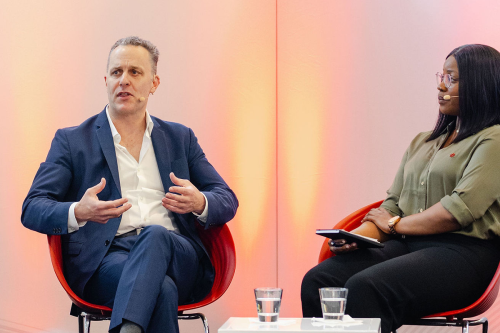
At The 2025 SUMMIT, Omotola Adogba, Fraud Business Analyst at Payments Canada, met with Phillip Straley, President of FNA, to share insights into the shifting dynamics of global payment fraud and the growing importance of collaborative, data-driven approaches to defense.

President
FNA
Over the last five years, we've seen a huge increase in digital payments and the interconnectedness of global systems. What new vulnerabilities are you seeing in the markets and what should we look out for in Canada?
Fraudsters are very smart, well-resourced and making very good use of new technology; whether that's GenAI, FraudGPT or otherwise. They’re generating new motifs around romance scams, investment scams and government-driven confidence games effectively. With the advent of instant payment systems, it's also become much easier and faster to move money out of the system once you have perpetrated a scam. Previously, it might have taken two or three or five days for the money to make its way out of the system after an authorized push payment (APP) scam occurred. Now, it often takes only a few hours. When you start to factor in cross-border payments or cryptocurrency conversion, these transactions become even more difficult to track and trace.
FNA currently plays a key role in Malaysia’s payments and banking fraud infrastructure. What makes Malaysia stand out? What is it that they're doing that makes other countries want to emulate them?
Malaysia has set up a National Scam Response Center, which is a shared service facility that sits inside Malaysia’s central bank. The banks, e-wallet providers and national law enforcement are all co-located in one office to coordinate scam and fraud responses. The NSRC is one of many such national co-location centres. What sets Malaysia apart is taking that next step of setting up a shared technology utility that can support the scam center and other users within financial institutions. This central utility, or “fraud portal”, includes a central fraud registry or data repository, case management automation between financial institutions and a real-time track and trace capability linking multiple payment rails. Now, when a scam occurs, FNA’s software is sitting on top of eight or nine different payment systems that make transactions visible to all the financial institutions in real time along the money laundering chain. Before their real-time track and trace and case management capabilities were live, the percentage of scammed funds that ended up going back to the victims was less than one per cent. Now that the shared infrastructure is in place, it's gone up to 30 per cent. In cases where it's reported within a few hours, it's close to 100 percent.
In anticipation of real-time payments soon becoming a reality in Canada with the Real-Time Rail (RTR), what recommendations do you have for Canada to enhance our fraud detection and defense capabilities?
First, I want to commend the approach that Payments Canada and the RTR delivery partners are taking to implement shared fraud technology for the industry on day one of the RTR’s launch. I’m not aware of any other jurisdictions that have done that, and they've felt the pain after seeing the incidents of scams accelerate. Now, of course, the faster payment systems do not create scams, but they can supercharge them. Getting out in front of the problem is a great step that I would recommend to any jurisdiction developing a real-time system.
After the RTR goes live, I would suggest that one of the next solutions Canada considers is a real-time track and trace capability. I also think that a shared technology infrastructure, like the National Scam Response Center in Malaysia I mentioned earlier, can help speed up fraud responses. Having that cross-section of experts face-to-face in one room makes a big difference.
Looking ahead, how do you see AI and simulation-based analytics contributing to the future of payments security on a global scale?
There are major contributions that can be made by machine learning-based models that use network-level data across payment rails. Workflow solutions can enable financial institutions to coordinate their response to attacks, whether that be authorized or unauthorized fraud, in a quick, automated way. Money tracing also allows financial institutions to quickly freeze funds and accounts so that, in as little as 15 minutes after a scam is reported, they’re able to freeze funds before they exit the system.
Obviously, there's a lot that technology can't do, so public awareness training is critical as well. If you are scammed, make sure to call your bank or a national hotline if there is one. If it's reported quickly enough, in many cases, the money gets frozen and is ultimately clawed back. I’d also suggest being open about your experience with your loved ones. Something as simple as sharing your experience can make others think twice about who they send money to.
Subscribe to The SUMMIT newsletter to get the latest updates on The SUMMIT, including agenda announcements, exclusive promotions, industry resources and more.