Driving efficiency, innovation and interoperability through ISO 20022 adoption
The shift to ISO 20022 is not just about adopting a new messaging standard — it’s about transforming the global payment ecosystem. Common data standards and harmonized market practices are key to unlocking efficiency, interoperability and innovation in payments.
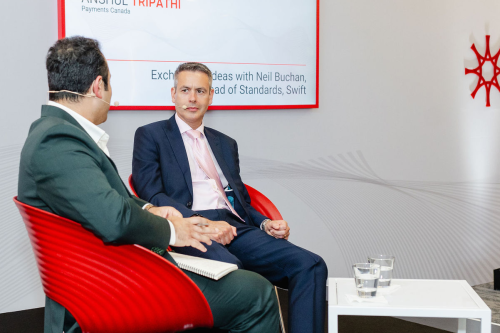
In this fireside chat at The 2025 SUMMIT, Anshul Tripathi, Manager, ISO 20022, Payments Canada, spoke with Neil Buchan, Head of Standards, Swift, about how collaboration, standardization and alignment on best practices are shaping the future of global payments.

Head of Standards
Swift
Why is standardization, particularly through ISO 20022, so critical in modern payment systems?
I see many opportunities in the global payment space. Whether you’re looking at domestic automated clearing house systems, cheque standards or customer-level formats, each country and institution has its own standards when it comes to initiating and processing payments.
Transformation, whether through standards, artificial intelligence or emerging technologies, only works if there is global collaboration behind it. Otherwise, we’re just repeating history and operating in the same, disconnected way. ISO 20022 gives us the opportunity to avoid that and unify the way we talk about and execute payments.
What are some of the limitations or deficiencies with the legacy payment standards and why is there a push within the payment industry to adopt ISO 20022?
There isn’t anything wrong with many of the legacy payment standards. They served their purpose at the time. The real challenge is when you get into a more globalized environment. Take remittance information, for example: different countries have different standards regarding how much data can be sent, how it’s structured or even what kind of content is allowed.
When you start to deal with cross-border payments, that inconsistency becomes a problem — especially for the end customer. If I’m trying to pay an invoice that’s structured in one country and it’s not structured the same in another, the details the end customers are getting is inconsistent.
With the adoption of a data-rich standard like ISO 20022, how do we ensure that the data is interpreted and populated consistently across different regions and institutions? Are we at risk of creating new inconsistencies if that collaboration doesn’t happen?
Absolutely. The payments space has seen significant innovation, and the same goes for communication. We now have far greater opportunities to bring diverse perspectives together to align on what we mean by certain terms, define clear use cases and properly document standards to ensure consistent interpretation. With the evolution of technology and the way the world has become more connected, we’re in a much stronger position to address some of the longstanding challenges that legacy standards have created.
According to data from Swift, there are almost 200 market infrastructures globally across payments and other financial services that have either implemented or are planning to adopt ISO 20022. How can we ensure consistent implementation and coordination across such a diverse landscape?
It’s reasonable to assume that each one of those countries has at least one market infrastructure responsible for financial stability. What we’ve often seen with legacy standards is that different countries and institutions describe and implement things in different ways.
From my perspective, what my standards team tries to achieve is a coordinating role in the industry, bringing groups together. The High-Value Payment Systems Plus (HVPS+) group, which focuses on the market infrastructure space, actually marked the beginning of the global ISO 20022 adoption journey. When several large market infrastructures began exploring ISO 20022, the direct participants saw the potential value, but also recognized the risk. Without coordination, we could have ended up repeating history, resulting in 200 different versions of the standards. That was seen as a major challenge that HPVS+ was created to address.
ISO 20022 is also being adopted across other payment infrastructures, like real-time rails and batch payment systems. What needs to be done to ensure a consistent approach to message adoption across all market infrastructures?
From an industry perspective, we can do a lot to ensure Canada aligns with the Fed, CHIPS, the Euro system or our colleagues in Australia and around the world. We can try to make the standards as efficient as possible, but ultimately, it comes down to the implementation strategy. That takes things a level deeper, something we still need to reflect on and continue to improve.
Recently, we formed the Instant Payments Plus (IP+) Working Group, of which Payments Canada is also an active member. The goal was to bring together all the instant payment infrastructures that have either implemented ISO 20022, looking to implement or exploring cross-border instant payments. It was primarily about aligning thinking. The next logical step is to bring that work together with high-value payments systems because the way a payment is settled shouldn’t affect how we structure and exchange the data.
As we approach the end of the coexistence period between legacy MT messages and the new ISO 20022 MX messages in November 2025, what are your thoughts on how the industry is progressing toward that milestone? How do you think we’re tracking overall?
Technically, we’re only retiring MT payment messages, not all MT messages. Trade, FX and securities messages will continue on Swift. The focus is on core payment messages, particularly those involving a chain of transactions. That transition is largely on track.
Looking ahead, once we’ve achieved global alignment on ISO 20022 across market infrastructures, what do you see as the future of standardization in payments? How do we unlock value from the ISO 20022 adoption?
The number one focus is collaboration. The payments industry is still evolving and will continue to evolve. ISO 20022, as a messaging and financial standard, whether in payments or other business areas, is critical. To unlock its full value, we need alignment on how we implement and use it.
Subscribe to The SUMMIT newsletter to get the latest updates on The SUMMIT, including agenda announcements, exclusive promotions, industry resources and more.