Layering defences: Fighting fraud through verified payment instruction
An interview with Shayle Rothman, Chief Executive Officer and Co-Founder of DoBusiness.com™.
As Canada’s payment landscape evolves, the industry faces a shared challenge: how to increase payment speed and innovation while keeping money movement safe. DoBusiness.com™ is focused on validating a payment instruction before money moves onto a payment rail.
In this Q&A, Shayle Rothman discusses the organization’s mission to create a safer ecosystem for Canadian consumers and businesses. He also reflects on the positive impact of expanded Payments Canada membership and the near- and long-term benefits of Canada's Real-Time Rail (RTR).
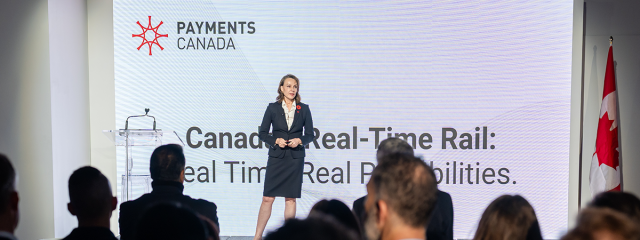
Learn more by watching Shayle’s keynote address at The 2026 Payments Canada SUMMIT. DoBusiness.com is also an executive-level sponsor of the 2027 event.

Chief Executive Officer and Co-Founder
DoBusiness.com™
What was the motivation behind your organization's decision to join Payments Canada?
Two reasons: one practical and one structural.
The practical reason is directness. We move money for clients every day, and membership under the eligibility that opened to RPAA-registered payment service providers in 2025 lets us hold that relationship directly rather than through another party.
The structural reason is timing. The RTR By-law (By-law No. 10) came into force on August 24, 2026, and the Real-Time Rail has officially launched. We would rather be in the room while the operational practice around a new system is being established than arrive after it has settled in.
The value of membership has been the quality of the room. Payments Canada convenes banks, credit unions, payment service providers and regulators around a common set of facts. As a company whose product depends on system-wide trust, that is not a networking benefit; it is the operating environment.
How will your organization use Canada's RTR to benefit Canadian consumers, businesses and the overall Canadian payment industry?
Every instant-payment system in the world has had to confront the same question: once settlement is final in seconds, the window to catch and redirect a payment instruction is very limited.
Our answer is that verification of the payment instruction must come first. Our product, DoStopFraud™, which complements an organization’s or the RTR’s existing centralized fraud services, verifies the payment instruction so that settlement speed does not work in the fraudster's favour.
For the industry, we will meet the fraud obligations the RTR framework sets for participants, including confirmation of payee, if and when we are approved to participate.
For consumers, the highest-consequence payment most Canadians ever make is a home closing. It is the largest single transfer of their life, into an account that is unfamiliar to them. That is the first payment class we chose to verify before money moves, as the RTR’s transaction limit is initially set at $100,000.
For businesses, real-time settlement combined with ISO 20022 structured remittance data means a payment can arrive with the references needed to reconcile it, so matching a payment to the obligation behind it stops being a separate task performed later.
Faster money is an improvement only if the instruction behind it is true.
What initial and long-term benefits do your organization and your clients expect to see from the use of the RTR?
Initially, three.
Speed with certainty. Our clients work in a market where a payment error is effectively unrecoverable. Real-time settlement means a payment can be completed immediately rather than over days, without giving up the certainty they are accountable for.
Better data. ISO 20022 allows remittance information to travel with the payment, so reconciliation stops being a separate task performed later against a bank statement.
Fewer channels. Every instruction that moves over a verified channel is one that did not move by email and fax, still the most common entry points we see for redirection fraud.
Long term, we expect the RTR to change what a payment is. Today a payment is a transfer of value with a memo field. We think it becomes a payment you can account for, one whose record is complete when it arrives rather than reconstructed weeks later. That record is what makes recourse possible when something goes wrong.
What piece of advice would you give a PSP considering Payments Canada membership?
Three things:
Be honest about why you are joining. Membership and participation carry obligations, and the framework expects you to meet the same fraud requirements as institutions many times your size. If you are planning to participate on the RTR, I encourage you to read the Real-Time Rail Participation Guide for Payment Service Providers and cost the work before you apply, not after.
Start the compliance work before you need it. Registration under the Retail Payment Activities Act, safeguarding, an audited control environment and fraud tooling all take longer than anticipated. The providers who struggle are rarely the ones who lack capability. They are the ones who left certification, testing and evidence to the end.
Membership expanded in 2025 to bring more kinds of providers into the system. Come prepared to meet the same standard as everyone else in the room.
Picture the Canadian payment landscape five years from now. What is one major change or achievement you hope your organization will have achieved through its membership?
Verifying a payment instruction becomes a baseline. Not an add-on a buyer has to specify. Not a question a consumer has to ask. Simply the standard Canadian payments are held to. If we have contributed to that, the achievement will not carry our name, and it should not. Infrastructure succeeds when it disappears. What we would like to have spearheaded is the standard, not the market share.
The second change we hope to see is the end of the assumption that speed and safety trade against each other. They do not, provided the instruction is verified before money moves.
About DoBusiness.com™
DoBusiness.com™ is Verified Trust Infrastructure (VPI): the trust layer through which businesses, regulated entities and their professional advisers verify identity and payment instructions before approving and releasing money, all within a secure closed loop system.